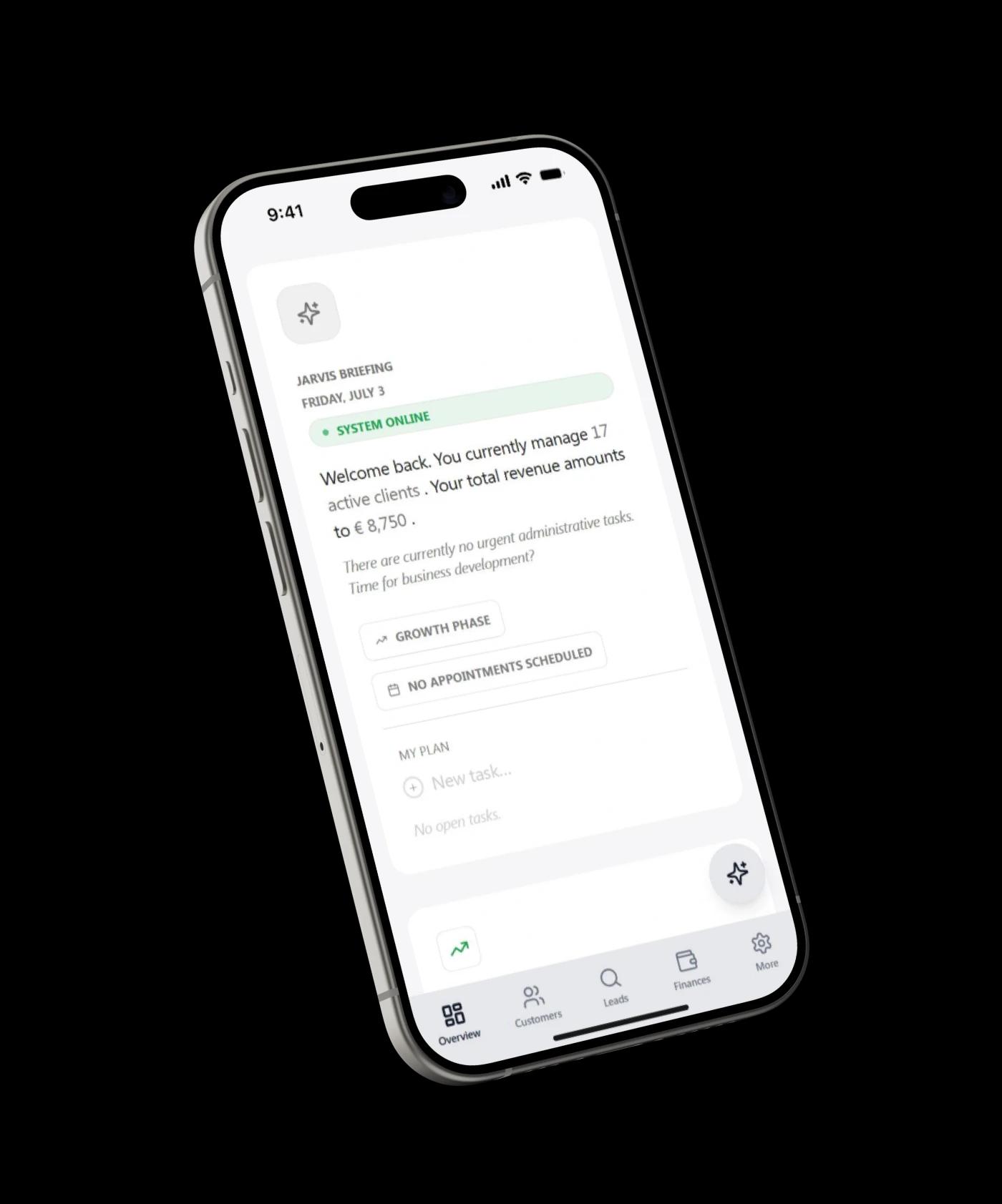
JARVIS is the internal operating system we built for 2Site and run our studio on every day. Clients, files, quotes, outreach, an AI assistant and our finances now sit in one place, from the first lead to the finished invoice.
For a long time we ran the studio across a handful of separate tools. Clients lived in one place, files in another, quotes in a third, and finding new clients happened on the side with nothing tied together. It meant too many tabs, a lot of copying between them, and no single place that showed where a project actually stood.
JARVIS closes that gap. It is our own business operating system, built for the way the two of us work, and it brings everything needed to run a project into one calm place. Because it is an internal project with no client and no confidentiality to protect, we can show openly how it is built and what it does.
 Claude API
One system to run the whole studio.
From many tools to one system.
The change is less about hours on a stopwatch and more about how the studio runs. Before, the work was spread across a handful of separate tools that did not talk to each other. Now everything needed to run a project lives in one place, from the first lead to the finished invoice, and it is in daily use.
We have not invented hour figures here, because the honest gain is structural. The studio no longer runs across a pile of disconnected tools; it runs on one system we shaped around our own work. That is why JARVIS is not a side experiment but the thing we open first every day.
We built the tool we wished existed, then ran the studio on it.
JARVIS started as a simple frustration: too many tabs, and nothing that talked to the rest. So we built our own operating system for the studio, one place that holds clients, files, quotes, outreach, an assistant and our finances, from the first lead to the finished invoice. It runs on a modern web stack, with a PostgreSQL database keeping the data together, the Claude API behind the assistant, and the Google Places API behind the lead finder. Because it is our own tool, shaped around the way the two of us actually work, it fits instead of forcing us to fit it. It is live, and we use it every day. Building it for ourselves is also how we learned, first-hand, what it takes to build a calm, connected system for someone else.